

Best Materials for Ear Gauges: Glass, Steel, Stone, Wood, Resin Compared
Choosing ear gauges should feel exciting, not confusing.
But once you start looking around, the options can get overwhelming fast. Glass plugs. Steel tunnels. Stone gauges. Wood plugs. Resin designs. Silicone earskins. Acrylic starter kits. Everyone seems to have a different opinion, and some advice online sounds way too dramatic.
So let’s keep this simple.
The best material for ear gauges depends on where your ears are in the stretching journey. Fresh or recently stretched ears need smooth, body-safe materials that are easy to clean. Fully healed stretched ears give you more freedom to wear organic materials like stone and wood. And for daily comfort, weight, flare style, and cleaning habits matter just as much as the material itself.
If we were talking as friends, I would put it like this:
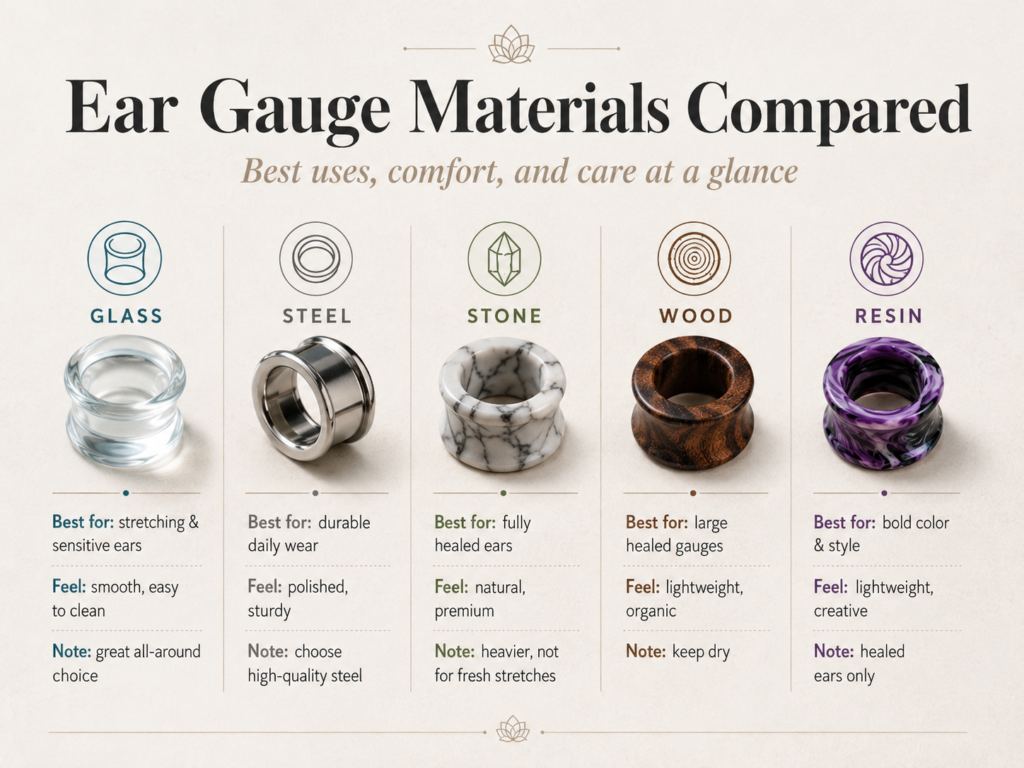
Glass is one of the safest and easiest choices for stretching and sensitive ears. Implant-grade steel or titanium is great for durability and a polished look. Stone plugs are beautiful for fully healed ears. Wood plugs are lightweight and natural, especially at larger sizes. Resin is fun for bold styles, but it should be worn with more care. Acrylic and low-quality mystery metals are the ones I would be most cautious with.
Let’s walk through each material so you can choose what actually fits your ears, your lifestyle, and your style.
Quick Answer: What Is the Best Material for Ear Gauges?
If you want the safest all-around choice, glass is usually one of the best materials for ear gauges. It is smooth, non-porous, easy to clean, and comfortable for many people with sensitive skin.
For fresh stretches, many professional piercers recommend body-safe glass, implant-grade titanium, or implant-grade steel. For fully healed ears, you can also enjoy stone, wood, resin, and other decorative materials.
Here is the simple version:
| Material | Best For | Use With Fresh Stretches? | Main Benefit |
|---|---|---|---|
| Glass | Stretching, sensitive ears, daily wear | Yes, if high-quality | Smooth and easy to clean |
| Implant-grade steel | Durable daily wear | Yes, if implant-grade | Strong and polished |
| Titanium | Sensitive skin, lightweight metal wear | Yes, if implant-grade | Lightweight and nickel-safe |
| Stone | Healed ears, natural style | No | Unique natural patterns |
| Wood | Healed ears, large gauges | No | Lightweight and organic |
| Resin | Healed ears, colorful designs | No | Creative and bold |
| Silicone | Healed ears only | No | Flexible and lightweight |
| Acrylic | Short-term fashion wear only | No | Cheap and colorful |
Now let’s look at each one in more detail.
1. Glass Ear Gauges: The Best All-Around Choice
Glass is the material I would recommend to most beginners first.
Why? Because good glass plugs are smooth, non-porous, and easy to clean. That means they do not trap as much buildup as porous materials. They also glide more comfortably through healed tissue when sized correctly.
For stretching, glass single flare plugs are especially popular. They have a smooth front, a wearable length, and one removable O-ring at the back. This makes them easier to insert than double flare plugs, especially when your ears are still adjusting to a new size.
Glass also works well if your ears get irritated easily. Some people react to certain metals, coatings, or cheap jewelry finishes. With quality glass, there is usually less guesswork.
That said, not every glass plug is automatically good. Look for lead-free borosilicate glass, fused quartz, or other body-safe glass used for body jewelry. Avoid painted glass, mystery coatings, or pieces with rough seams.
Pros of Glass Ear Gauges
Glass has several major benefits:
- Smooth surface
- Easy to clean
- Good for sensitive ears
- Often suitable for stretching
- Available in many colors
- Usually not too heavy at smaller sizes
Cons of Glass Ear Gauges
Glass can break if dropped on a hard floor. It can also feel slightly heavier at larger sizes. If you are clumsy in the bathroom, take them out over a towel instead of a tile sink.
Best For
Glass is best for beginners, fresh stretches, sensitive ears, and anyone who wants a clean, simple material that works in most situations.
2. Stainless Steel Ear Gauges: Durable and Polished
Stainless steel is one of the most common materials for plugs and tunnels. It has a clean, shiny look and works well for many everyday styles.
Steel plugs are strong, durable, and easy to clean. They are especially popular for tunnels, industrial designs, and inlay plugs. A polished stainless steel base can also pair beautifully with shell, stone, or other decorative details.
But here is where you need to be careful: not all “surgical steel” is the same.
Some cheap steel jewelry can contain nickel or lower-quality alloys that may irritate sensitive ears. If you have metal sensitivity, steel may not be your best choice unless the jewelry is clearly made from implant-grade steel.
For healed ears, polished stainless steel can be a practical option. For fresh stretches, it is better to choose implant-grade steel or ask a professional piercer for guidance.
Pros of Stainless Steel Ear Gauges
- Very durable
- Easy to clean
- Sleek polished look
- Great for tunnels
- Works well for daily wear
- Usually affordable
Cons of Stainless Steel Ear Gauges
Steel can feel heavy in larger sizes. It may also cause irritation for people with nickel sensitivity if the grade is not clearly stated.
Best For
Stainless steel is best for healed ears, polished styles, tunnels, industrial designs, and people who want low-maintenance jewelry.
3. Titanium Ear Gauges: Great for Sensitive Skin
Titanium is one of the best metal options for body jewelry, especially for people with sensitive skin.
It is lighter than steel, strong, and often used for high-quality body jewelry. Implant-grade titanium is also a common recommendation for initial piercings and healing piercings.
For ear gauges, titanium is a great choice if you want metal jewelry but steel feels too heavy or irritating. It is usually more expensive than stainless steel, but it can be worth it if your ears are picky.
The only downside is style variety. Titanium plugs and tunnels may not offer the same natural texture as stone or wood. They often look clean, simple, and modern.
Pros of Titanium Ear Gauges
- Lightweight
- Strong
- Good for sensitive skin
- Less likely to contain irritating nickel
- Suitable for high-quality body jewelry
Cons of Titanium Ear Gauges
Titanium usually costs more than stainless steel. It may also have fewer decorative options if you want natural patterns or bold inlays.
Best For
Titanium is best for sensitive ears, lightweight metal wear, fresh stretches when professionally approved, and minimalist jewelry lovers.
4. Stone Ear Gauges: Beautiful, Natural, and Best for Healed Ears
Stone plugs are where ear gauges start to feel personal.
Every pair looks a little different. Obsidian has a deep black shine. Tiger’s eye has golden bands that move in the light. Rose quartz feels soft and warm. Labradorite can flash blue, green, or gold depending on the angle.
That natural variation is the whole point. Stone plugs do not look mass-produced. They feel grounded, tactile, and more connected to personal style.
But stone is not for fresh stretches.
Natural stone should only be worn in fully healed ears. Even when polished smooth, stone can be heavier than glass, wood, or silicone. Some stones may also have tiny natural variations in texture. That is fine for healed lobes, but not ideal for irritated or newly stretched tissue.
If your ears are fully healed, stone can be one of the best materials for everyday style. It feels premium, looks unique, and works especially well for minimalist, gothic, earthy, and alternative aesthetics.
Pros of Stone Ear Gauges
- Unique natural patterns
- Premium look and feel
- Great for healed ears
- Wide range of colors
- Smooth polished surface
- Strong visual identity
Cons of Stone Ear Gauges
Stone can be heavier than other materials. It can also chip if dropped. Most importantly, it should not be used for fresh stretches or irritated ears.
Best For
Stone plugs are best for fully healed stretched ears, natural jewelry lovers, crystal-inspired styles, and anyone who wants plugs that feel one-of-a-kind.
5. Wood Ear Gauges: Lightweight and Organic
Wood plugs are a favorite for people with larger stretched ears.
The reason is simple: wood is lightweight. Once your ears get to bigger sizes, heavy plugs can pull on your lobes during the day. Wood gives you a natural look without the same weight as stone or steel.
Wood also has a warmer feel. It does not feel as cold as metal or stone when you first put it in. The grain patterns make each pair look different, and woods like ebony, wenge, sandalwood, and bamboo can create a calm, earthy style.
But wood needs care.
Wood is porous, so it should only be worn in healed ears. It should not be worn in fresh stretches, irritated ears, or wet environments. Do not shower or swim with wood plugs. Water can damage the material and affect the finish.
You should also oil wood plugs occasionally with a suitable jewelry-safe oil, such as jojoba oil, to help prevent drying.
Pros of Wood Ear Gauges
- Very lightweight
- Comfortable at larger sizes
- Warm natural texture
- Great for organic style
- Good for long daily wear in healed ears
Cons of Wood Ear Gauges
Wood is porous and needs more care. It should stay dry and should not be used in healing ears.
Best For
Wood plugs are best for healed ears, larger gauges, lightweight comfort, and natural minimalist styling.
6. Resin Ear Gauges: Colorful, Creative, and Lightweight
Resin plugs are fun. That is their biggest strength.
You can find resin plugs in bright colors, swirls, glitter effects, embedded designs, and shapes that are difficult to create with stone or metal. If you want something bold, playful, or artistic, resin gives you a lot of freedom.
Resin is also usually lightweight, which makes it comfortable for larger sizes.
However, resin quality matters a lot. Cheap resin jewelry may have rough edges, poor curing, or low-quality finishes. That can irritate your ears. Resin should only be worn in fully healed lobes, and you should avoid using it for stretching.
For daily wear, check the surface carefully. It should feel smooth all around, with no sticky texture, sharp seams, or uneven coating.
Pros of Resin Ear Gauges
- Lightweight
- Colorful
- Good for creative designs
- Often affordable
- Comfortable for healed ears
Cons of Resin Ear Gauges
Resin quality can vary. It is not ideal for fresh stretches, irritated ears, or long-term wear if the finish feels rough.
Best For
Resin plugs are best for healed ears, colorful statement looks, occasional wear, and lightweight fashion styles.
7. Silicone Ear Gauges: Flexible, But Only for Healed Ears
Silicone plugs and earskins are popular because they are soft, flexible, and lightweight. They can be comfortable, especially in larger sizes.
But silicone has one important rule: only wear it in fully healed ears.
Do not stretch with silicone. Do not put silicone in a fresh stretch. Silicone can expand inside the ear and put pressure on the tissue. That can cause irritation, soreness, or worse.
For healed ears, high-quality silicone can be useful when you want something soft and light. It is also common for people who like a minimal tunnel look.
Pros of Silicone Ear Gauges
- Very lightweight
- Flexible
- Comfortable in healed ears
- Good for casual wear
- Available in many colors
Cons of Silicone Ear Gauges
Silicone is not for stretching. It should not be used in fresh, sore, or irritated ears.
Best For
Silicone is best for fully healed ears, lightweight casual wear, and larger sizes where comfort matters most.
8. Acrylic Ear Gauges: Cheap, But Not the Best Choice
Acrylic plugs are everywhere because they are cheap, colorful, and easy to find.
But I would not call acrylic one of the best materials for ear gauges. It is more of a budget fashion option, and it comes with more concerns than the other materials on this list.
Acrylic can be harder to clean properly. It may develop scratches that trap buildup. Some low-quality acrylic jewelry can also have rough seams or questionable finishes.
If you already own acrylic plugs, it is better to treat them as short-term fashion jewelry for fully healed ears. Do not use acrylic for stretching. Do not wear it in irritated ears. And do not sleep in it if your ears react badly.
Pros of Acrylic Ear Gauges
- Cheap
- Lightweight
- Colorful
- Easy to find
Cons of Acrylic Ear Gauges
Acrylic is not ideal for long-term wear, fresh stretches, or sensitive ears. Quality varies widely.
Best For
Acrylic is best for short-term wear in fully healed ears, if your ears tolerate it well.
Best Ear Gauge Materials by Situation
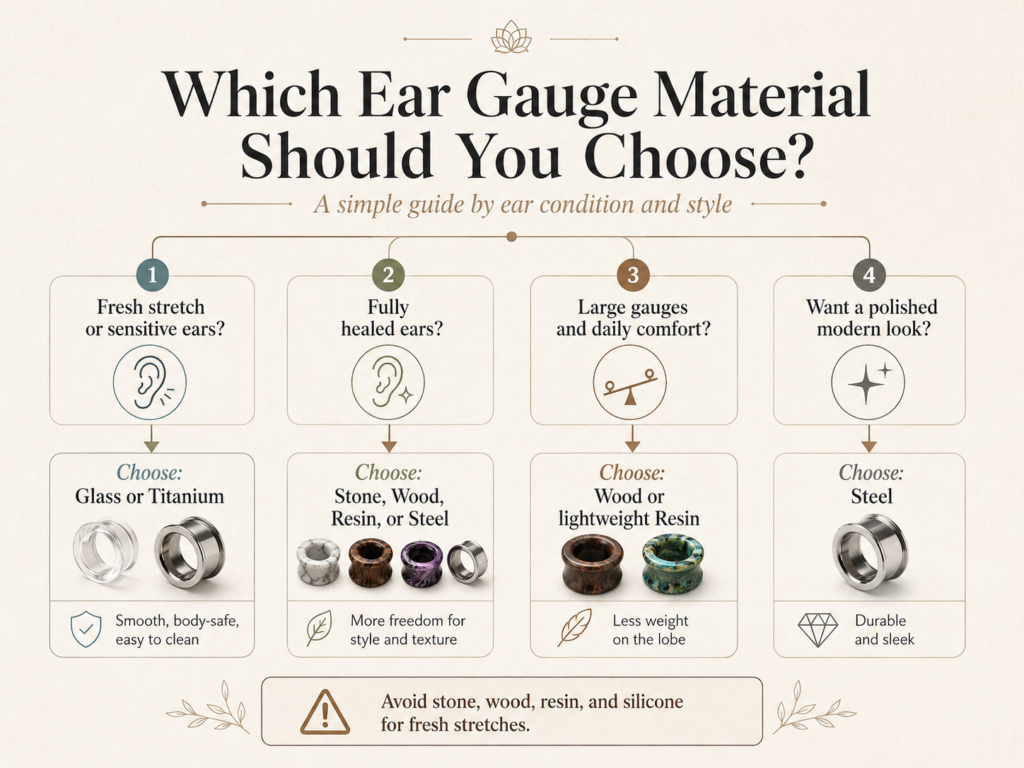
Still unsure? Here is the easiest way to choose.
If You Are Stretching Your Ears
Choose glass single flare plugs first. Implant-grade titanium or implant-grade steel may also be suitable if the jewelry is high quality.
Avoid stone, wood, resin, silicone, and acrylic for fresh stretches.
If Your Ears Are Fully Healed
You have more options. Stone, wood, steel, resin, glass, titanium, and silicone can all work, depending on your comfort and care habits.
If You Have Sensitive Ears
Start with glass or implant-grade titanium. Be careful with mystery metals, cheap steel, acrylic, and low-quality resin.
If You Wear Large Sizes
Wood, silicone, and some resin plugs can feel more comfortable because they are lightweight. Stone and steel can look amazing, but they may feel heavy after long wear.
If You Want Natural Style
Choose stone or wood. Stone gives you color, shine, and mineral patterns. Wood gives you warmth, grain, and earthy texture.
If You Want Low-Maintenance Jewelry
Glass, titanium, and stainless steel are easier to clean than porous materials. Stone is also fairly easy to care for when polished, but it should still be handled gently.
Fresh Stretch vs Healed Ears: This Part Matters
The biggest mistake people make is choosing jewelry based only on looks.
I get it. A pair of stone plugs or wood tunnels can look much better than plain glass stretching plugs. But your ears do not care how cool the jewelry looks if the tissue is still healing.
Fresh stretches need smooth, clean, non-porous materials. They also need time. If your ears feel hot, sore, swollen, tight, or angry, do not force jewelry in. Wait. Downsize if needed. Talk to a professional piercer if something looks wrong.
Once your ears are fully healed, then you can enjoy more decorative materials.
Think of it like shoes. You would not wear stiff boots on a fresh blister. You would let the skin calm down first, then wear the fun pair later.
Your ears deserve the same patience.
Our Honest Recommendation
If you are new to ear stretching, start with glass.
If your ears are healed and you want something natural, try stone plugs or wood plugs.
If you like a clean modern look, stainless steel or titanium is a strong choice.
If you want bold colors or artistic designs, resin can be fun for healed ears.
And if you are not sure what your ears like yet, keep it simple. Choose smooth, high-quality jewelry. Clean it often. Do not rush sizes. Your ears will tell you what works.
At Auralithplug, we focus on natural stone plugs, wood gauges, resin plugs, and stainless steel styles for stretched ears. Our pieces are selected for people who want jewelry that feels personal, textured, and connected to their style — not just another basic pair of gauges.
If your ears are fully healed, you can explore natural stone plugs for a grounded, one-of-a-kind look. If you want something lighter, wood plugs are a great everyday choice. If you prefer polished structure, stainless steel tunnels and inlay plugs may fit your style better.
The best material is not always the trendiest one. It is the one your ears can wear comfortably and your style can grow with.
FAQs About Ear Gauge Materials
What is the safest material for ear gauges?
Glass is one of the safest all-around materials for ear gauges, especially for stretching and sensitive ears. Implant-grade titanium and implant-grade steel are also strong choices when quality is clearly verified.
Are stone plugs safe for stretched ears?
Yes, stone plugs can be safe for fully healed stretched ears. They should not be used for fresh stretches, irritated ears, or healing tissue.
Are wood plugs good for stretched ears?
Wood plugs are good for fully healed ears, especially at larger sizes because they are lightweight. They should stay dry and should not be worn while swimming or showering.
Can I stretch my ears with silicone plugs?
No. Do not stretch your ears with silicone plugs or earskins. Silicone should only be worn in fully healed ears.
Are acrylic plugs bad for your ears?
Acrylic plugs are not the best choice for stretching, sensitive ears, or long-term wear. If you wear acrylic, use it only in fully healed ears and avoid low-quality pieces with rough seams or poor finishes.
What material is best for sensitive ears?
Glass and implant-grade titanium are usually the best choices for sensitive ears. Avoid mystery metals, cheap coated jewelry, and rough porous materials if your ears react easily.
What material is best for large gauges?
Wood, silicone, and lightweight resin are often comfortable for large gauges because they reduce weight on the lobe. Stone and steel can still be worn, but they may feel heavier over time.
Should I choose plugs or tunnels?
Choose plugs if you like a solid front design, natural stone patterns, or a heavier visual look. Choose tunnels if you prefer an open center, lighter feel, or a more minimal stretched ear style.